



Digital Economy|Cross-border e-commerce station is on the wind, Hebei foreign trade takes advantage of the momentum
On March 14, Zhangjiakou Cross-border E-commerce Digital Trade Industrial Park opened for operation. As the first cross-border e-commerce industrial park in Zhangjiakou, the industrial park will become a new highland for the city's foreign trade exports and economic growth.
Cross-border e-commerce is a legitimate outlet. Enterprises in Hebei province seize the new trend of overseas online consumption, use cross-border e-commerce to expand exports, and inject new momentum into the smooth "dual cycle". Relevant departments have promoted cross-border e-commerce as an important starting point for promoting the transformation and upgrading of foreign trade and gathering new momentum, providing important support for the province's stable foreign trade volume expansion and quality improvement.

At Christmas 2020, employees of Yingdong’s cross-border e-commerce platform’s overseas warehouse in Ghana carried out holiday promotions.
Cross-border e-commerce spurs trade reform
On April 13, more than 150 sales staff of Shijiazhuang Offit Instruments Co., Ltd. conducted online contacts with overseas customers through the company's official website and Alibaba International Station.
Offfit is a cross-border e-commerce company that produces and sells medical and sports protective gear. Taking advantage of the "home economy", home sports products are popular overseas, and the company's total sales in 2020 have increased significantly compared with 2019.
After entering the cross-border e-commerce B2B export field for more than ten years, Li Xiaojing, general manager of Shijiazhuang Offfit Medical Equipment Co., Ltd., clearly felt the market's growing popularity. "There are more and more competitors, and we must be more customer-oriented and do the products well." Li Xiaojing said that they will launch new products every month, optimize logistics and other supporting functions, and further enhance the competitiveness of the company.
The epidemic has changed the traditional ecology of world trade and has led to a substantial shift in consumption of overseas residents to online. For traditional foreign trade companies, cross-border e-commerce has become a new outlet for transformation. The cross-border e-commerce trade method has also gradually developed from a single B2B export to the small cross-border wholesale and retail fields mainly B2C and C2C.
Tangshan Tuopu Biotechnology Co., Ltd. is an enterprise engaged in the production of yeast and yeast derivatives. In 2019, they developed a series of functional health foods and established their own brand by extracting glucan, active peptides and other ingredients from yeast. While upgrading their products, they are also transforming from traditional foreign trade to cross-border e-commerce, opening stores on platforms such as Amazon and eBay to meet end users directly. Compared with the previous traditional foreign trade that sold yeast raw materials in large quantities, the price of orders for selling deep-processed products of self-owned brands on cross-border e-commerce platforms is higher, and profits have also increased significantly.
More and more individual sellers are beginning to take a share in the cross-border e-commerce field.
Hu Jiaao is a college student who has recently graduated. In 2020, he has studied abroad and applied to become a customer service staff of a well-known cross-border e-commerce platform. During half a year of work, he saw the future development of cross-border e-commerce, and opened an adult products store on AliExpress after resigning. In the third month after opening the store, sales reached US$3,000.
Like Hu Jiaao, there is an increasing number of individual sellers buying goods from domestic channels and selling overseas on cross-border e-commerce platforms. While providing employment for them, cross-border e-commerce has also created new ways for more “Made in China” to go overseas.

On April 21, at the cross-sea cross-border (Shijiazhuang) digital trade comprehensive service base, students were listening to courses on cross-border e-commerce operations. Photo by Hebei Daily reporter Feng Yang
Short board above the tuyere highlights
On the morning of April 14, at the Cross-Sea Cross-Border (Shijiazhuang) Digital Trade Comprehensive Service Base, more than 20 trainees were listening to courses on cross-border e-commerce operations.
Every week, 2-3 training activities will be organized here, involving the construction and operation of cross-border e-commerce platforms, logistics services, etc., and follow-up coaching will be provided to the trainees. "We are like a'custodial class', giving students who want to engage in the cross-border e-commerce industry an enlightenment from stage 0 to stage 1." said Liu Hongyan, deputy general manager of the base.
Since its official operation in March last year, the base has incubated more than 100 cross-border e-commerce companies. At the same time, they also give online lectures for 13 colleges and universities including Hebei Normal University and Hebei Preschool Vocational and Technical College.
Even with the participation of many institutions and universities, cross-border e-commerce professionals are still in short supply. The cross-border e-commerce major is an interdisciplinary subject, and companies have higher requirements for the comprehensive ability of talents.
When recruiting employees, Li Xiaojing found that talents with experience in cross-border e-commerce in the market are relatively limited, and the increasing gap has also increased labor costs. "Our Shenzhen branch recruited operating personnel, and employee salaries have increased by about 50% compared to last year." Li Xiaojing said, even so, these new recruits cannot fully meet the needs of the company and still need to be re-trained at the practical level.
Incomplete infrastructure is also one of the bottlenecks restricting the development of cross-border e-commerce. Among them, logistics bear the brunt.
Chen Xiaodong said that for companies like Tuopu Biotech that are still in the infancy of cross-border e-commerce, logistics costs are almost the same as product manufacturing costs. Last year, affected by the epidemic, international shipping prices continued to rise, and logistics costs were even higher than product manufacturing costs. Overseas warehouses can achieve lower logistics costs and faster delivery time, but they also make enterprises face problems such as high inventory pressure and high storage costs.
In order to help enterprises further reduce logistics costs, the cross-sea and cross-border (Shijiazhuang) digital trade comprehensive service base extends warehousing, logistics and other service functions for more than 100 settled enterprises to achieve large-scale and intensified product exports.
Relevant experts said that a large number of fragmented and customized orders are generated in current cross-border trade, and the business path is very different from traditional trade. It is urgent to speed up the establishment of new regulatory models, relevant tax collection and management standards, technical standards and other rules. In addition, cross-border e-commerce requires companies to accurately analyze changes in consumer demand and transform the traditional "order economy" into a "demand economy", which poses certain challenges to the business management of the company.
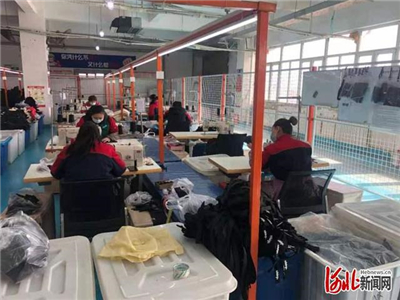
In the production workshop of Shijiazhuang Offfit Apparatus Co., Ltd., workers are busy on the production line.
Policies help build a new ecosystem
In the second half of last year, the Yingdong cross-border e-commerce platform under the Yingdong Group started the import of agricultural products such as sesame, peanuts, and metal mines on the basis of expanding exports. With the gradual expansion of the scope of import and export business, the background system of the platform has also been iteratively upgraded to provide convenience for more users.
The Yingdong cross-border e-commerce platform integrating foreign trade services, platform transactions, and overseas warehouses is located in Tangshan City. Since its operation at the end of 2018, 176 companies have settled on the platform. In 2020, the transaction volume of the platform reached US$10.91 million, an increase of 81.8% over 2019.
Behind the achievements is the result of the joint efforts of government and enterprises to make up for shortcomings and promote development.
In 2018, Tangshan City was approved to become the first cross-border e-commerce comprehensive trial zone in Hebei Province. Thanks to the policy support of the comprehensive pilot zone, Yingdong Group has made great progress in cross-border e-commerce integrated services, overseas warehouses, and cross-border trade.
In recent years, through the construction of a comprehensive cross-border e-commerce service platform, Tangshan City has completed the construction of all customs clearance service functions such as 9610, 1210, 9710 and 9810; cultivated 9 cross-border e-commerce parks with various characteristics, forming a "3+3 +N" space layout; successively introduced well-known companies such as Qianfeng Supply Chain, Koala Technology, and Dixintong, and landed and discussed nearly 100 cross-border e-commerce projects. Since the introduction of the special fund management measures for cross-border e-commerce in 2019, a total of 259 projects have been supported, effectively promoting the rapid development of cross-border e-commerce in the city.
Today, cross-border e-commerce has become the new economic growth pole of Tangshan's foreign trade. According to incomplete statistics, in 2020, cross-border e-commerce will stimulate the export of local manufacturing products by 11.5 billion yuan and the import of beauty cosmetics, mother and baby, and daily chemical products by 18.46 million yuan.
Shijiazhuang City has also adopted various policy support to accelerate the development of cross-border e-commerce.
In 2020, Shijiazhuang City issued the "Measures to Promote the Rapid Development of Cross-border E-commerce", which put forward 21 measures in terms of park construction, talent introduction, and financial rewards. The comprehensive public service platform of Shijiazhuang Cross-border E-commerce Comprehensive Pilot Zone was officially launched, and the main business models and regulatory policies of cross-border e-commerce were officially implemented. At present, 10 regular all-cargo international routes from Shijiazhuang to Russia, Germany, the Philippines and other countries have been opened, and 7 cross-border e-commerce industrial parks have been cultivated.
To seize the trend of cross-border e-commerce, actively build a high-quality development ecosystem of cross-border e-commerce, and take active actions in various parts of Hebei Province. The relevant person in charge of the Provincial Department of Commerce stated that Hebei Province will continue to create an excellent cross-border e-commerce development environment, create a new engine and inject new momentum for the innovative development and high-quality development of Hebei's foreign trade. (Feng Yang, Hebei Daily reporter)

